What the hell are full-stack designers?
3 February 2021
Have you ever heard the term "full-stack developer"? Sure! But have you ever heard the term "full-stack designer"? In computer science, the term "full-stack" usually applies to software or web developers who have the skills to work both on the client side (front end) and on the server side (back end), including the database and the server set-up. In this way, a single person covers all the stacks of the development process and the technologies it uses. But what are those stacks when it comes to a full-stack designer?
Design process
The purpose of visual, digital or communication design can be described as organizing the given information in the most efficient way, to improve the human experience on both a rational and an emotional level. This makes the design output easier to consume and more widely accepted, which means that every application of design goes through the following process.
The design process always begins by defining the problem during the briefing. Research then uses different methods to break it down into elements that can be analyzed, which turns the request into concrete requirements. Those requirements leave empty spots for ideation, the brainstorming phase where all the creativity happens and potential solutions are created to fill them.
The next step is a proof of concept (PoC) of the chosen ideas: the prototype. This step is important because it is the last turning point before more investment is required. This is why testing usually happens twice, before and after the implementation. The same steps appear in the five stages of design thinking taught at the Stanford d.school: empathise, define, ideate, prototype and test ¹.

This cycle seems to be discussed mostly in experience design, but in reality the design process, whether it is neglected or not, is (or should be) applied in all forms of design. While the market tends towards narrow specialization and divides this process between different roles, full-stack designers have a larger set of tools for prototyping and implementation, follow the principles of the design process and play a key part in each phase (UX → the skill sets needed to apply the design). The industry calls them unicorns because they're rare, but I call them (wo)men of the Renaissance.
Corky, but I'll explain later...
The design stacks
Back to the question: what are those stacks?
Actually, it depends on the project you're in. In a startup that creates mobile apps, for example, a full-stack designer could be responsible for the design process (of course), the startup or product branding, UX, UI and some front-end development to implement the UI, and maybe some marketing materials as well (graphic design and motion, for example). On the other hand, in the communication department of, let's say, a social association, a full-stack designer would mainly be responsible for everything the association does visually. In this case, graphic design, branding, video editing and motion would make up the full stack.
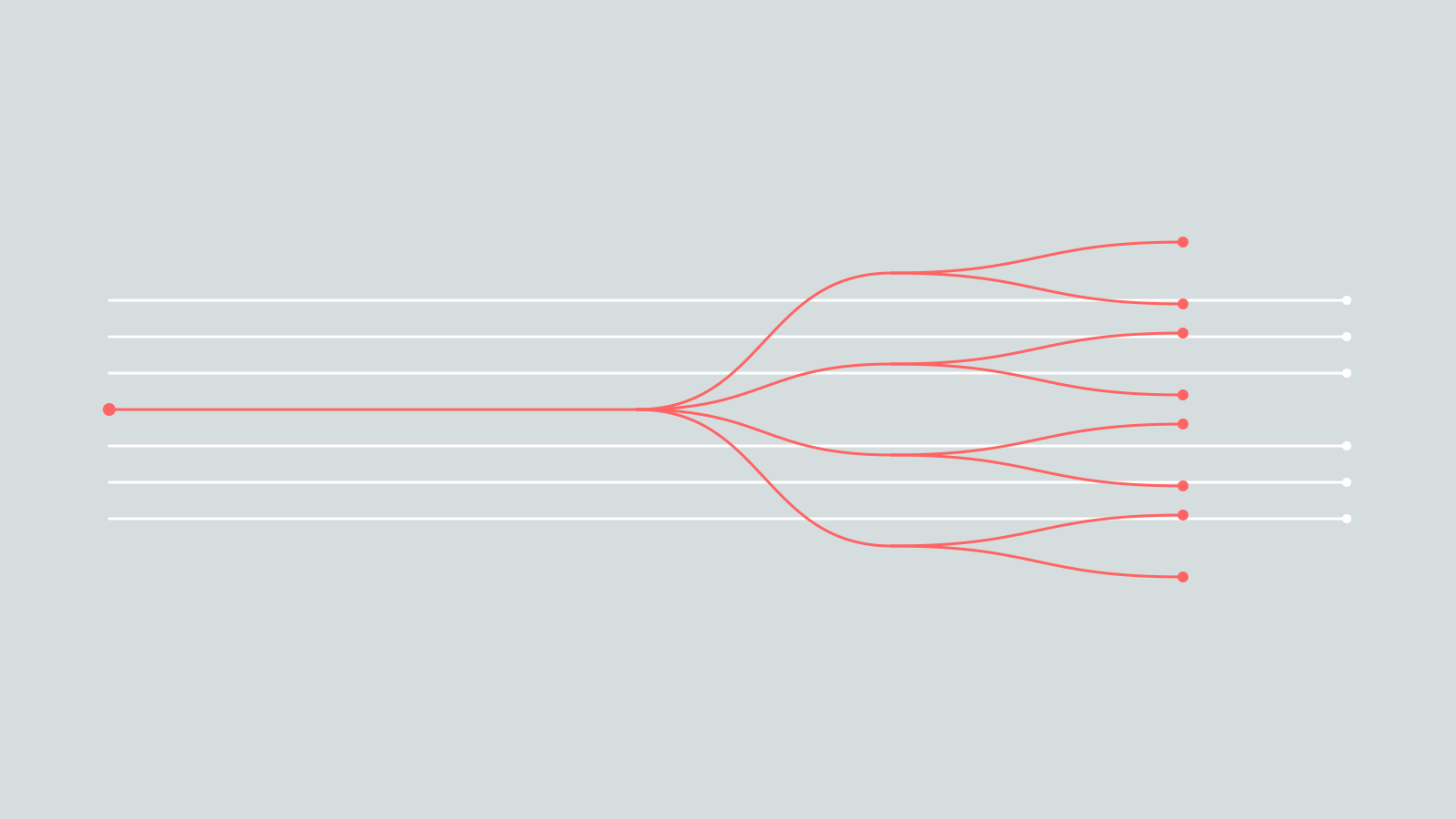
There are many design stacks one can acquire, so full-stack designers are not all the same; it usually depends on the context of the projects they work in. Outside a project, they are designers with a wide range of skills, in other words generalists. The following graphic shows some of the stacks one may have.

-
Identity design (aka branding), where the identity of a company, product or service and its guidelines are developed and maintained (logotypes, the corporate design system, etc.).
-
Digital product design, where design is used to create the assets and the user interface of a digital product or service. Usually websites, web apps, software or mobile apps.
-
Graphic design, commonly marketing, presentation and illustration assets. It may be digital (web banners, presentations, illustrations) or editorial (flyers, posters, magazines, books, etc.).
-
Motion design, animation and motion graphics, usually extended to video editing and visual effects, even though these last two are not strictly design.
-
Instructional design, which turns raw research and content into a didactic, interactive output. The discipline is decades old (its best-known model, ADDIE, was developed at Florida State University for the US Army in 1975 ²), but it has become very popular with e-learning. Courses usually come as web pages or interactive interfaces that follow the SCORM standard ³.
-
Front-end development. Wait, what?! Some designers come with the web development skills needed to bring their UX and UI proofs of concept to life, usually HTML, CSS/SCSS and, more advanced, JavaScript.
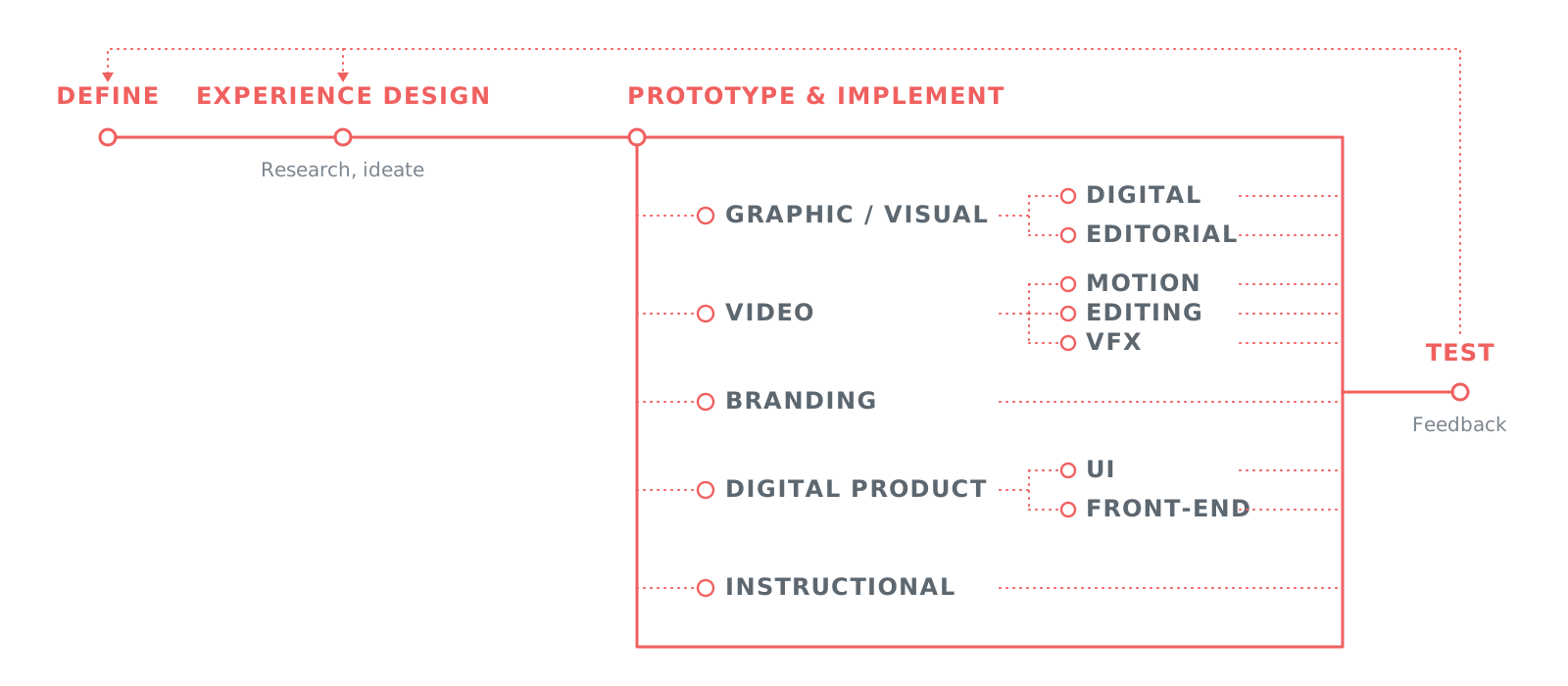
Also, look at how those stacks fit into the design process.
I hope you now understand why full-stack designers are usually referred to as unicorns, especially when it comes to hiring one for a project. One question you may be asking is: how can one person become competent in so many different fields?
To answer it, I need to explain how full-stack designers emerged...
The tale of a unicorn
The short answer is multimedia.
The long answer is that you've probably heard the term "multimedia design" and of the multimedia courses that popped up at many universities in the mid-2000s. These courses were both theoretical and practical, from project management and graphic design to development, video capture and editing, and motion design. Didn't make sense at the time, but Universities thought it did.
Since very few people really knew what multimedia was all about, these courses seemed to teach everything connected with the term, or with what it was thought to be, and above all to mix it all together, usually in Adobe Flash with ActionScript 2 or 3. Flash was then killed by responsive design, HTML5 and Apple: Ethan Marcotte coined "responsive web design" in 2010 ⁴, the same year Steve Jobs published his "Thoughts on Flash" ⁵, and Adobe ended support for Flash Player on 31 December 2020 ⁶.
The term "multimedia" fell into disuse and now simply describes the different types of media, usually motion and audio. The mindset of gathering know-how on tools and methods to mix the development processes together, the "multimedia designer", fell into disuse as well because it was misunderstood, and the terms "generalist designer" and "full-stack designer" emerged.This generalist approach to design and digital media focuses on the design process itself, rather than on its nature or the tools used. Design tools are what they really are, and always have been: just tools, the means to an end.
Full-stack design: pros and cons
There's a problem if you specialize in something narrow, and there's a problem if you don't.
Pros
- The big picture of the project and of the design process itself, as well as an awareness of the different options in the project development pipeline.
- Lots of possibilities. With a wider set of skills, a generalist or full-stack designer can do a lot of things, use different stacks and mix them, and jump into each project with a fresh mind. If you are one, you know you will never get bored at work.
- Lots of opportunities. A large skill set means you can fit in literally anywhere: startups or big corporations, IT, marketing or design agencies, marketing departments, game studios, online and offline media, e-learning companies, etc. In the end, who said you have to be full-stack in every job?
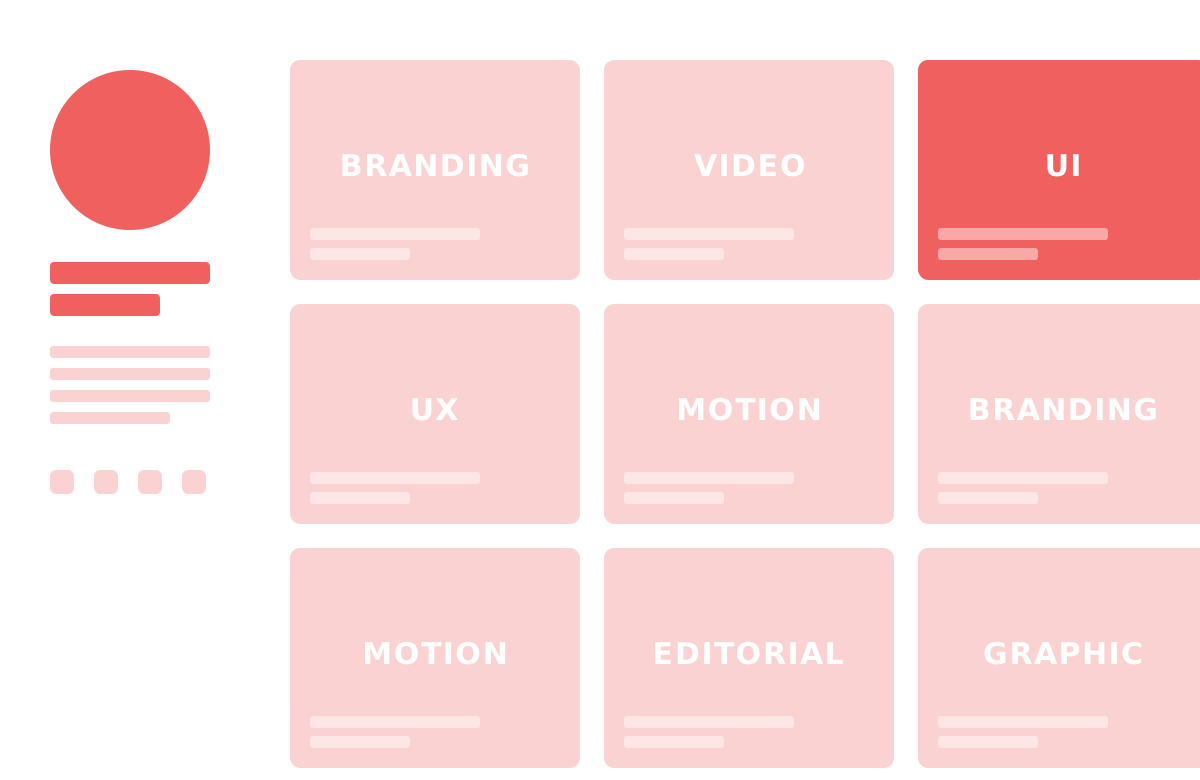
- A rich and abundant portfolio. Being a polymath in a certain field gives you the opportunity to impress a potential employer by showing how you perform across your range. It shows how fluent you are in the stacks you list on your resume, so your portfolio may look like the one you see above.
- Hollistic managers. Being full-stack lets you deeply understand the product development pipeline. It also helps you communicate with the other team members, and be more accurate and realistic about project assignments and deadlines. You also understand the difficulties that may arise better, and you can check quality more objectively than a generic manager. It is a technocratic approach, though!
- If you are a company hiring a full-stack designer. You may pay more for the role, because full-stack designers have wider skills and can cover a lot of blank spots, but you still pay less than you would to hire a different professional for each stack.
Cons
- A long stairway to heaven. Being a full-stack designer doesn't mean those skills fell from the sky or came through a special channel to the cosmos. Each skill has to be learned, mastered and polished before one can compete with specialized designers.
- A highway to hell. Knowing about each stack and doing a little in each is not mastery. One may become just a generalist designer with superficial skills, or a technician if the design process is neglected. In full-stack design, the skills are supposed to be competitive, not just ones you are aware of.
- A rich and abundant portfolio. You saw this one in the pros, right? Well, hell with that... That's because it's both a blessing and a curse. Let's say you are applying for a UX design position at your dream company and your portfolio looks like the one above. When your potential employer opens your resume and portfolio, they see that most of your entries have nothing to do with the position you applied for. That's a problem, and a big NO.
- Hard to progress. This one hurts. In the pros, I mentioned that full-stack designers make the best team leads and project managers, right? If you are good and experienced, it's true. But who said your management is willing to lose a person who does the work of a whole department for, let's say, 70k a year (depending on your country)? By promoting you to manager, the company needs to hire three or four new people (depending on the number of stacks you have) to replace your work.
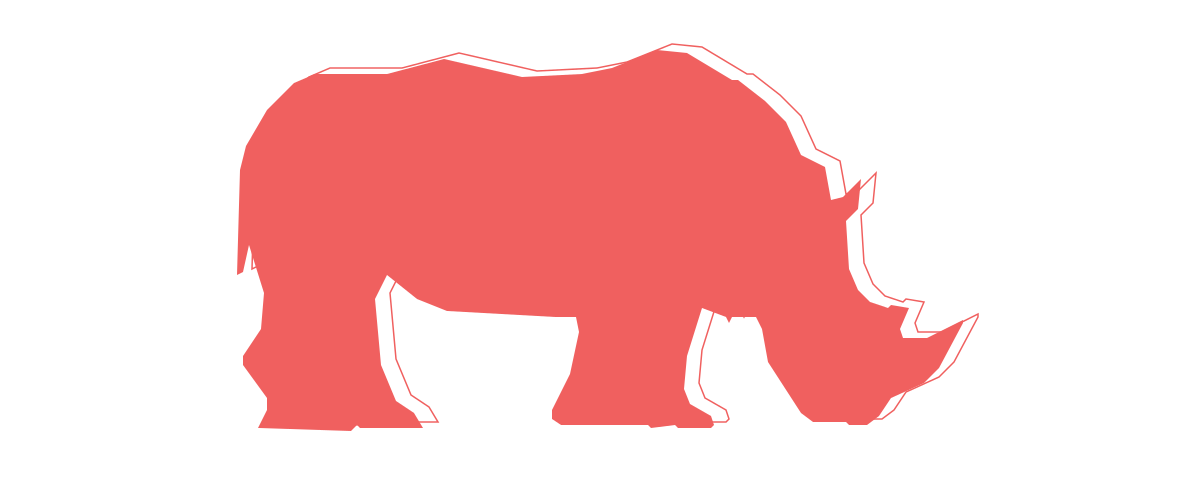
The rhino who thought he was a unicorn
Rhinos are strong and powerful animals, without a doubt, but they are not unicorns. There is a thin line between generalist and full-stack designers.
Full-stack designers are certainly generalists, but the reverse is not always the case. While generalists can be described as professional designers with a wide skill set, full-stack is not a profession, it's a manifestation. You only become full-stack in the context of a project or a company, where you have all the design stacks the development pipeline requires.
Final thoughts
I see a lot of articles about full-stack or generalist designers versus single-stack or specialised designers, but there are no rights and wrongs. Some say "the more you know, the less you know", others "better a Renaissance polymath than a 20th-century production line worker", but it really doesn't matter.

"Those who want to be good at everything become great at nothing..." — Albert Einstein
Albert Einstein never said that. I just used his face for fun.
Specialized designers are more likely to become advanced specialists in a certain field, but it is only a higher probability, not a rule. Research points the same way: specialists do best in "kind" fields with clear rules and quick feedback, while generalists tend to do better in "wicked" ones, where the rules are unclear and keep changing ⁷. Hiring has a name for the mix, too: the "T-shaped" professional, with broad knowledge across disciplines and depth in one, a term first used in 1991 ⁸. Both types may become great or awful professionals, each has pros and cons, and each is most attractive to different companies in different contexts. Each may take bigger risks or shine in a different situation. You can find good and awful professionals in any field, whatever the number of skill sets they have.
In conclusion, whether you are a designer, manager, student, HR, CEO or just curious, I want to believe I helped you understand what full-stack design really is, how you can become one, why they fit into companies and how to find a unicorn. I hope this article is one of many and that it raises more awareness of full-stack in fields other than web and software development. Full-stack designers are out there, just like full-stack marketers and others.
When it comes to being full-stack, I see only one problem: describing yourself briefly in a LinkedIn headline for algorithms... :) Have fun!
References
- Hasso Plattner Institute of Design at Stanford, An Introduction to Design Thinking: Process Guide (2010).
- Robert K. Branson et al., Interservice Procedures for Instructional Systems Development (Florida State University, 1975).
- Advanced Distributed Learning Initiative, Sharable Content Object Reference Model (SCORM).
- Ethan Marcotte, "Responsive Web Design", A List Apart (25 May 2010).
- Steve Jobs, "Thoughts on Flash", Apple (29 April 2010).
- Adobe, Adobe Flash Player End of Life (support ended 31 December 2020).
- David Epstein, Range: Why Generalists Triumph in a Specialized World (2019).
- David Guest, "The hunt is on for the Renaissance Man of computing", The Independent (17 September 1991).
First published on LinkedIn on 3 February 2021.