Do you remember WannaCry?
13 May 2026
How a hunch about an old hard drive saved a company from ransomware, and why creative problem solving isn't only for creative fields.
WannaCry?
Back in 2017, my parents-in-law had an insurance company that got hit by WannaCry, ransomware that encrypted your computer's files and demanded money to unlock them. In May 2017 alone, it hit more than 200,000 victims in at least 150 countries ¹. Naturally, all the contracts and documents were on those computers, and the whole business was on the line.
Everybody was panicking. The IT support company basically said: "Yeah, there's no protection against this ransomware. You'd better pay those Bitcoins and hope the hackers do their part." But I, a genius of unmatched logic and intelligence, solved this little problem in a few hours. Besides my profession(s), I'm a tech enthusiast and, basically, an old-school geek.
How? By being a genius, of course. :)
Breadcrumbs
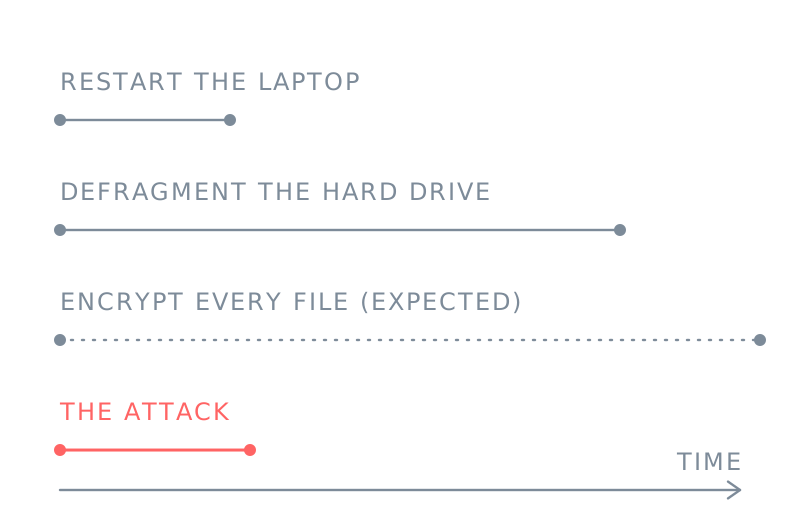
Most computers at the time still used HDDs instead of SSDs. And to me, the attack seemed way too fast. Like crazy fast. Like computer-reboot fast. Pretty much faster than defragmenting a hard drive used to take back then. So it got me thinking... And after extensive research that took place in my head, the conclusion was: "There's no fucking way the worm can encrypt files that fast on this old laptop. Either Toshiba's budget laptops are hiding something from us, or there is something else."
...and the "something else" thought was: What if the encryption wasn't happening at a low level, on the files themselves, but only at the registry level?
🤔
Solution
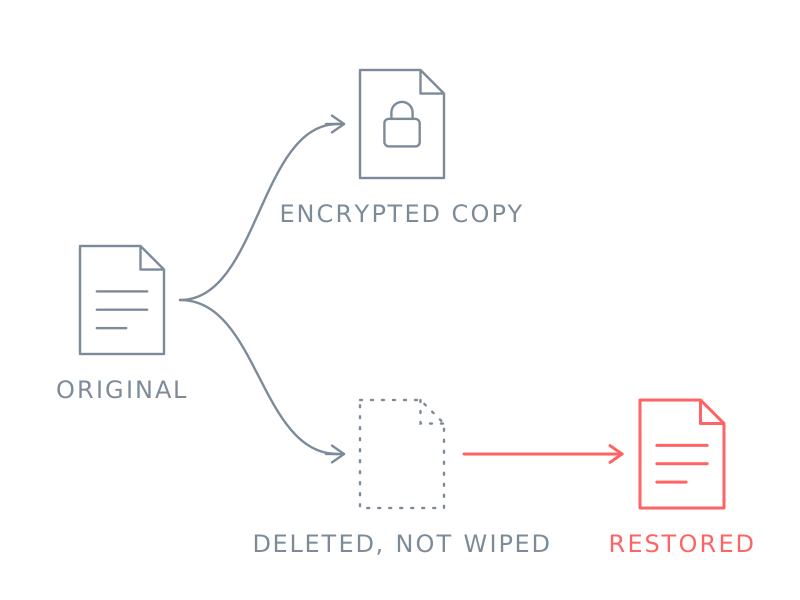
So I downloaded a portable version of a tool called ShadowExplorer onto a USB stick and opened it on the infected computer. It lets you browse the shadow copies, the point-in-time snapshots Windows keeps of the disk, and get back earlier versions of files that were changed or deleted ². On HDDs, a deleted file doesn't actually disappear either, until its blocks get rewritten or the drive gets wiped (overwritten with 0s).
So I scanned the drive and voilà, all the files were there. Even the deleted ones, and those I'd prefer to forget. I copied everything onto an external drive, formatted the infected machines and reinstalled Windows.
A few weeks later, Kaspersky's researchers explained why files could come back. WannaCry didn't lock files in place: it wrote an encrypted copy and then deleted the original. Only in a few folders, such as Desktop and Documents, was the original overwritten first. Elsewhere it was simply deleted, so recovery tools could often restore it ³.
Suddenly, I became the personal hero of my girlfriend (now fianceé) and of all the employees at that company who were about to lose their jobs. Meanwhile, I got a "cool, thanks" from my parents-in-law, because they didn't understand the gravity of the situation or the genius of the solution. 🤷♂️
The problem is that back in 2017, besides being a genius, I was also an idiot and didn't turn this into a business. Image... Today, I'd probably be writing this not from an apartment, but from my own private island.
Jokes aside: not genius, divergence
There was no genius involved, and nothing I did that day was hard. The IT company surely knew more about networks and security than I did. What happened is that we looked at the problem from different sides.
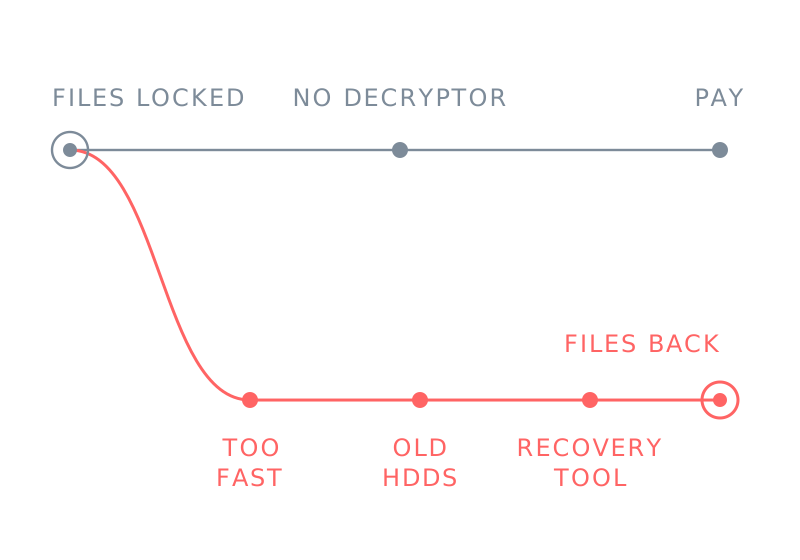
Their path was straight and logical: the files are encrypted, there's no decryptor, so you pay. That's convergent thinking, and it ended with Bitcoins.
My path went sideways: the attack was too fast, old hard drives don't really delete files, and there's a recovery tool made for a completely different problem. That's divergent thinking, which I wrote about in Unless divergent, you're not creative.
Psychology even has a name for what blocks the sideways path: functional fixedness, the habit of seeing an object only through its usual use. In Karl Duncker's candle problem, people had to fix a candle to a wall with a box of thumbtacks and matches. Many struggled, because they saw the box only as a box, not as a shelf for the candle ⁴. A recovery tool is "for deleted files". Unless you look at it differently.
Creativity isn't only for creative people
Creativity is usually filed under art, design and advertising. But it's simply the ability to find new solutions to a problem, and problems exist in every field.
- Business. In 2010, IBM asked more than 1,500 CEOs from 60 countries what the successful company of the future would need most. They named creativity the number one leadership competency, ahead of rigor, management discipline, integrity and even vision ⁵.
- Work in general. In the World Economic Forum's Future of Jobs Report 2025, creative thinking is one of the core skills employers value most: 57% of them named it, right after analytical thinking, resilience and leadership ⁶.
- Science. Nobel laureates are far more likely than the average scientist to have an artistic hobby: at least 7 times more likely to do visual arts or crafts, 12 times more likely to write, and 22 times more likely to perform as actors, dancers or magicians ⁷.
Knowing different areas solves real problems
Real problems don't care about job titles. WannaCry was a security problem, but it was solved with knowledge of hardware, of how hard drives delete data and of a tool nobody in the room thought was relevant. At the same time, it was a business problem: contracts, clients and people's jobs.
Research on 17.9 million scientific papers found the same pattern. The papers with the most impact were built on a solid base of conventional knowledge, plus an unusual combination from another area, and they were nearly twice as likely to become highly cited ⁸. It's the same idea behind full-stack designers: the more areas you know, the more paths you can try when the obvious one ends with "pay the hackers".
So, the moral of the story is: when I tell my customers that I solve their problems, I don't mean it in the Russian-accent way. I mean that their problems actually get solved. In product design, UX, IT, strategy, innovation or business operations.
I have an old Guy Fawkes mask somewhere, but it doesn't mean a thing. 😎
References
- Al Jazeera, "Ransomware attack hit 200,000 victims in 150 countries", quoting Europol director Rob Wainwright (May 14, 2017).
- ShadowExplorer, shadowexplorer.com.
- Anton Ivanov, Fedor Sinitsyn and Orkhan Mamedov, "WannaCry mistakes that can help you restore files after infection", Securelist, Kaspersky (June 1, 2017).
- Karl Duncker, "On problem-solving", Psychological Monographs 58, no. 5 (1945).
- IBM, Capitalizing on Complexity: Insights from the 2010 IBM Global CEO Study (May 2010).
- World Economic Forum, The Future of Jobs Report 2025 (January 2025).
- Robert Root-Bernstein et al., "Arts foster scientific success: Avocations of Nobel, National Academy, Royal Society, and Sigma Xi members", Journal of Psychology of Science and Technology 1, no. 2 (2008).
- Brian Uzzi, Satyam Mukherjee, Michael Stringer and Ben Jones, "Atypical combinations and scientific impact", Science 342 (2013).
First published on LinkedIn on May 13, 2026.