Unless divergent, you're not creative
16 January 2019
Many would say that the most important characteristic in the development of the human species is intelligence. It's true. The capacity to analyze and adapt brought us from a monkey to a human, and from a human to a Communist... I meant to the top of the food chain.
The Divergents
To survive, our species learned to change the world as it saw fit, adjusting its behavior to find workarounds and solve the problems it faced. This eventually led to science, to understand the phenomena around us, and to technology, to compensate for what we lack, giving us abilities we could never have dreamed of, and to a whole new system of managing and preserving information: culture. Today, thanks to psychology, we understand much more about the mechanisms of the human mind, and we have discovered a new "subspecies", rich in abilities and largely responsible for the progress described above: the Divergents.
...Sounds like the plot of a teenage film? Kind of. But sensationalism aside, our evolution did come from developing the skills to solve problems, first to survive and then to achieve more than we were originally capable of. And of course there is no subspecies called the Divergents, but how did humans solve problems in a way that brought us to where we stand now?
The ideation
The answer is quite simple, yet complex: By generating new ideas.
In today's world, especially in business, problem-solving skills are highly valued and go by different names: "thinking outside the box" or "creativity". Whole professions were created around it, such as user experience design and design thinking, where people constantly search for new ideas and methods to improve things and solve problems in a given context. But can everyone be creative and think outside the box? Yes.
The ability works on a spectrum, but not everyone develops it to the same level. High levels of divergence are rare, and I'll explain why.
Joy Paul Guilford (1897–1987) was a psychologist who devoted his career to studying human intelligence. In 1950, as president of the American Psychological Association, he urged psychologists to study creativity, a subject they had largely ignored. He went on to develop the Structure of Intellect (SI) theory, according to which a person's performance in intelligence tests can be traced back to underlying mental abilities, or factors of intelligence. The model organizes these abilities along three dimensions: operations, contents and products. It started with 120 abilities, later grew to 150 and finally to 180. Two of its operations are ways of producing answers: convergent and divergent thinking.
By the way, standard IQ tests measure mostly convergent thinking. Divergent thinking needs its own tests, such as Guilford's Alternate Uses task (how many uses can you find for a brick?) or the Torrance Tests of Creative Thinking (1966), which score the number, variety and originality of the answers.
Convergent thinking
Convergent thinking is the mental ability to give the "correct" answer or make the right decision in a given situation, choosing from the available possibilities. It is what we call logic, or "vertical thinking" ¹, because the process runs in a straight line towards the decision, through directly related associations: problem → analysis → possible solution → validation.
Convergent thinking is well developed in most people, because normal brain functioning depends on it. The divergent operator is not.
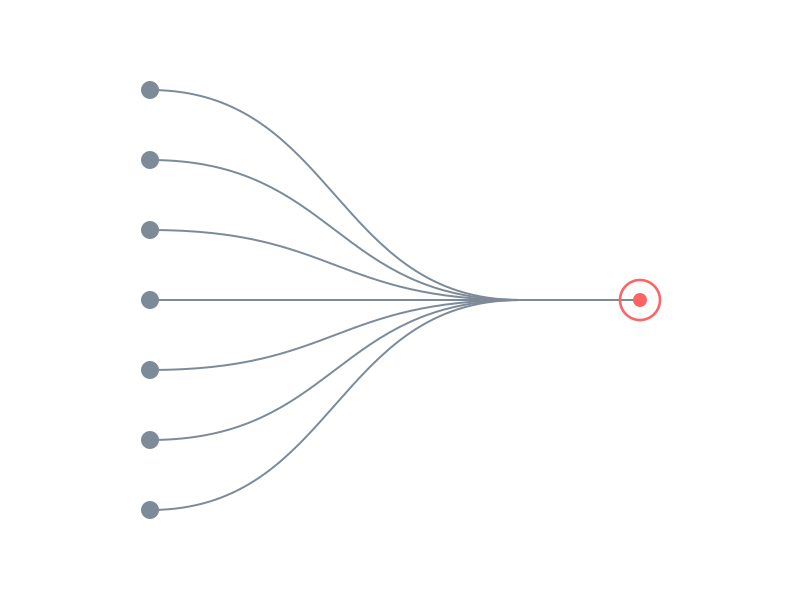
Convergent thinking. Start with information, converge on a solution.
Divergent thinking
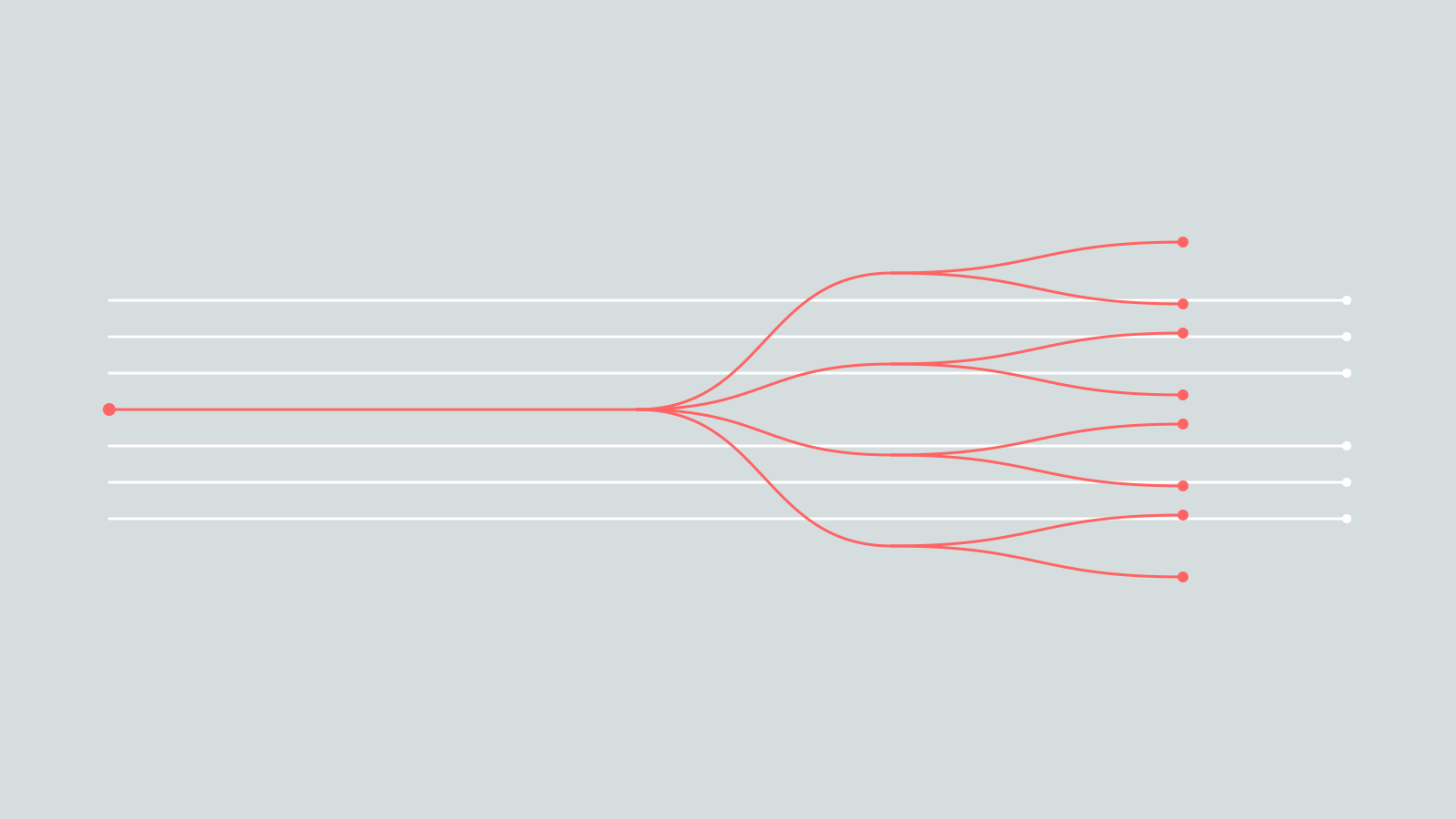
Divergent thinking, on the other hand, is the ability to generate new ideas that are not directly or logically related to the given situation. The process is non-linear, which has nothing to do with thinking randomly.
When a person comes up with an idea, it connects to other ideas through loose associations, so the mind moves sideways across ideas and explores new possibilities. Edward de Bono described a closely related process as lateral thinking ¹.
The divergent operator doesn't work alone. Its ideas need to be validated, and this is where the convergent operator comes in: it analyses the new ideas and organises them into a logical thesis. In other words, every new idea must be traced back logically.
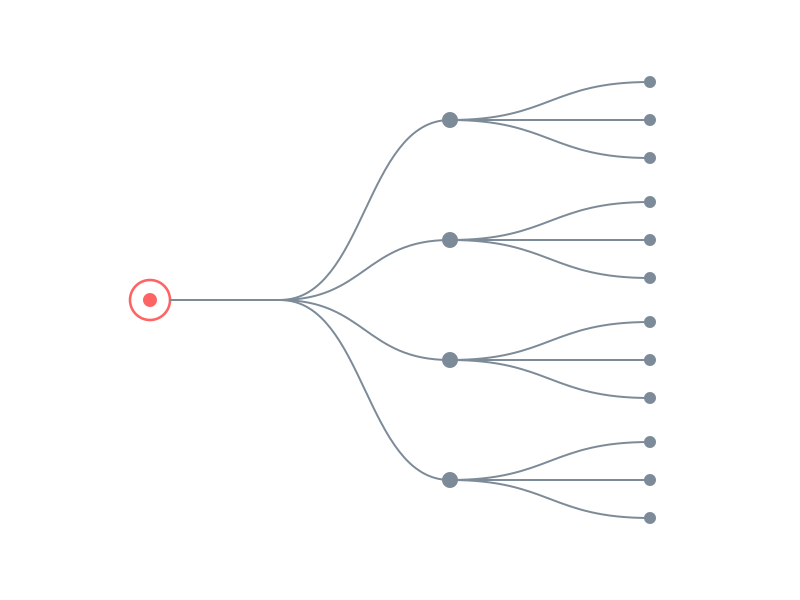
Divergent thinking. Start with a prompt, generate many solutions.
Studies show that divergent thinking is strongly correlated with personality traits. It was expected to be found mostly in people working in the arts, but it wasn't. In divergent thinking tests, high scores came from people in many different fields who share traits such as nonconformity and curiosity ² ³. The most consistent of them is openness to experience ³.
So are the best problem solvers mental rebels?
In a way, yes. They don't conform to established patterns and are interested in everything, so they question (or reject) what exists and look for new paradigms, which tends to drive progress. You have to be divergent to be creative and to be good at complex problem solving.
But this is not the holy grail: everything comes at a price. Studies have found a link between creativity and schizotypal traits, such as unusual perceptions, magical thinking and impulsive nonconformity ⁴. The link concerns personality traits, not illness, and across studies it is small ⁵.
Still, the role of creative people in business and cultural progress is indispensable. When divergent thinking is applied pragmatically, it is very effective for problem solving and innovation. The process is illustrated below, and design teams know it as the Double Diamond ⁶: first diverge to explore the problem, then converge on a decision.
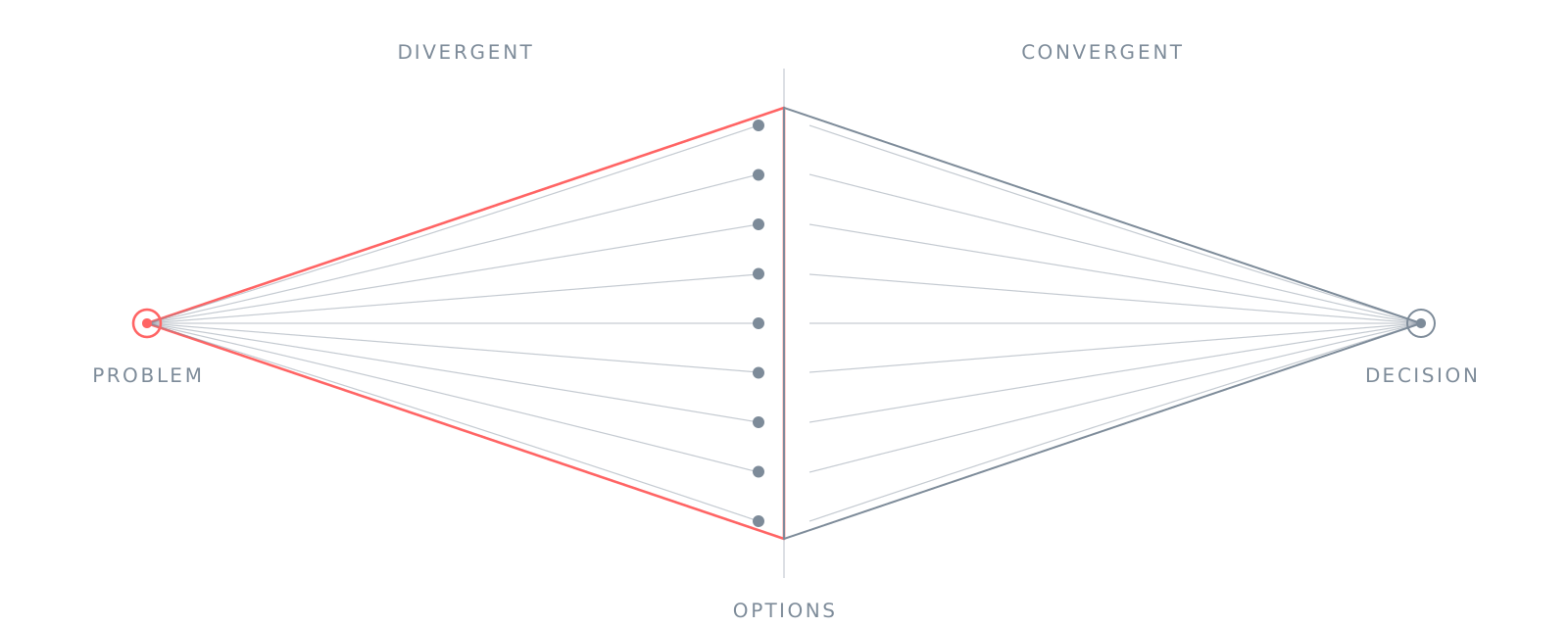
Divergent thinking widens the range of options; convergent thinking narrows it down to a decision.
Divergents can work in many intellectual fields, from management and engineering to the arts and more analytical work, because creativity is not tied to the arts. It is about managing information and creating new paradigms beyond the reach of logic. It is worth increasing your own level of divergence by practising curiosity and nonconformity, so that the mind stays open, which improves problem solving. This works: a review of 70 creativity training studies found clear gains in divergent thinking ⁷. And the more things you are interested in, the more you know, and the more material you have for the divergent process. In short, being divergent gives you the power to create and to solve problems in a given context.
The world we live in today was created by people with high levels of divergence: creative people who didn't conform to the time and the possibilities they were limited by, and who wanted to explore new paradigms. This is why it is so important to develop divergent thinking.
References
- Edward de Bono, The Use of Lateral Thinking (1967).
- Carole Wade and Carol Tavris, Invitation to Psychology (2008).
- Robert R. McCrae, "Creativity, divergent thinking, and openness to experience", Journal of Personality and Social Psychology 52(6) (1987).
- David Schuldberg et al., "Creativity and schizotypal traits", Journal of Nervous and Mental Disease 176(11) (1988).
- Selcuk Acar and Sedat Sen, "A multilevel meta-analysis of the relationship between creativity and schizotypy", Psychology of Aesthetics, Creativity, and the Arts 7(3) (2013).
- Design Council, The Double Diamond.
- Ginamarie Scott, Lyle E. Leritz and Michael D. Mumford, "The effectiveness of creativity training: a quantitative review", Creativity Research Journal 16(4) (2004).
- J. P. Guilford, "Creativity", American Psychologist 5(9) (1950).